
- Home
- About Us
- Solutions
CMMs
- Bridge CMMs
- Gantry CMMs
- Shop Floor CMMs
Portable Measuring Arms
- Absolute Arm 7 Axis
- Absolute Arm 6 Axis
- Absolute Arm Compact
- Resources
- Industries
- Contact Us

With Cold Metal Fusion (CMF) technology and the qualification of the Sinterit Lisa X platform, manufacturers can now explore metal 3D printing without investing in traditional metal printers, using a polymer SLS system instead.
This development represents a major shift toward accessible, scalable metal manufacturing.

ColdMetalFusion (CMF) is a sinter-based metal additive manufacturing technology developed by Headmade Materials.
Unlike laser-based metal printing technologies, CMF separates the process into two clear stages:
1️⃣ Green Part Printing
Metal feedstock containing metal powder and a thermoplastic binder is printed on a polymer SLS system.
Only the binding powder is melted during printing at low temperatures below ~80°C while the metal powder remains solid.
2️⃣ Debinding & Sintering
The printed green parts are debound then processed in a furnace, where the binder is removed and metal particles fuse into a dense, fully metallic component.
Key difference:
Metal properties are achieved during sintering, not during printing.
CMF feedstocks are engineered to work specifically on polymer powder bed fusion (SLS) platforms.
During the printing process:
This enables:
The result is a simpler, more flexible metal AM workflow compared to conventional metal printing.
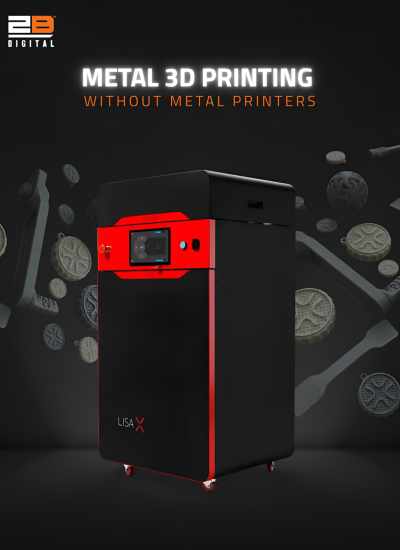
Headmade Materials has officially qualified the Sinterit Lisa X for printing CMF metal feedstocks.
This qualification confirms that:
It’s an important milestone toward making metal additive manufacturing more accessible to manufacturers who already use or plan to adopt SLS technology.
 By
2B Digital
By
2B Digital


Delivering Digital Manufacturing Solutions since 2000

All Rights Reserved | 2B DIGITAL © 2025
جميع الحقوق محفوظة | 2B Digital © 2025
صمم بواسطة Thinkadv